
How We Worldschooled – Annika’s Family
Our third, fourth, and seventh graders were in a Waldorf School back home, and the teachers were supportive and encouraging of our year away. I brought hard copies of the larger yearly project assignment sheets: animal report, shelter project, and biography. We took advantage of the New Zealand libraries to complete them. The kids wrote monthly postcards to their classes, and their teachers used our wanderings as teachable moments, too. We tried to follow the Waldorf philosophy of little to no screens, but we softened over time.
It was important for me to keep the kids aligned with math back home. As their teacher, I felt the least comfortable with math, so I relied heavily on paperback workbooks from local bookstores. I didn’t do much research but found ones that covered roughly the same material as our school did. It was important to me that these books were lightweight. We supplemented with Khan Academy when we could. It was challenging to have enough bandwidth in most rentals to have more than one kid online at one time.
We focused our third and fourth graders on memorizing their times table. We often quizzed them with flash cards when waiting for a train and sang the times table while hiking, and the kids quizzed each other while Will and I were busy doing something else. Mastery of the 7s was cause for celebration with ice cream. We didn’t need a formal curriculum to do any of this. The kids often say now that having their times table memorized has served them well.
For writing, we created writing portfolios and read a lot. My three kids read somewhere between fifty and a hundred books each during our Wonder Year! We kept a list, like an informal bibliography. As we hiked, my son would give me plot updates from his books. We would simply discuss them, and I would ask clarifying questions and what his predictions were—but all in a conversational style. It didn’t feel like school; it felt like shared curiosity.
My kids’ fondest memory when they look back upon our worldschooling “curriculum” was the luxury to have the time to read for interest and pleasure. Whenever we had Wi-Fi, we would download ebooks onto their iPad. My husband and I were always reading books aloud in the evenings with the younger ones. I miss those days!
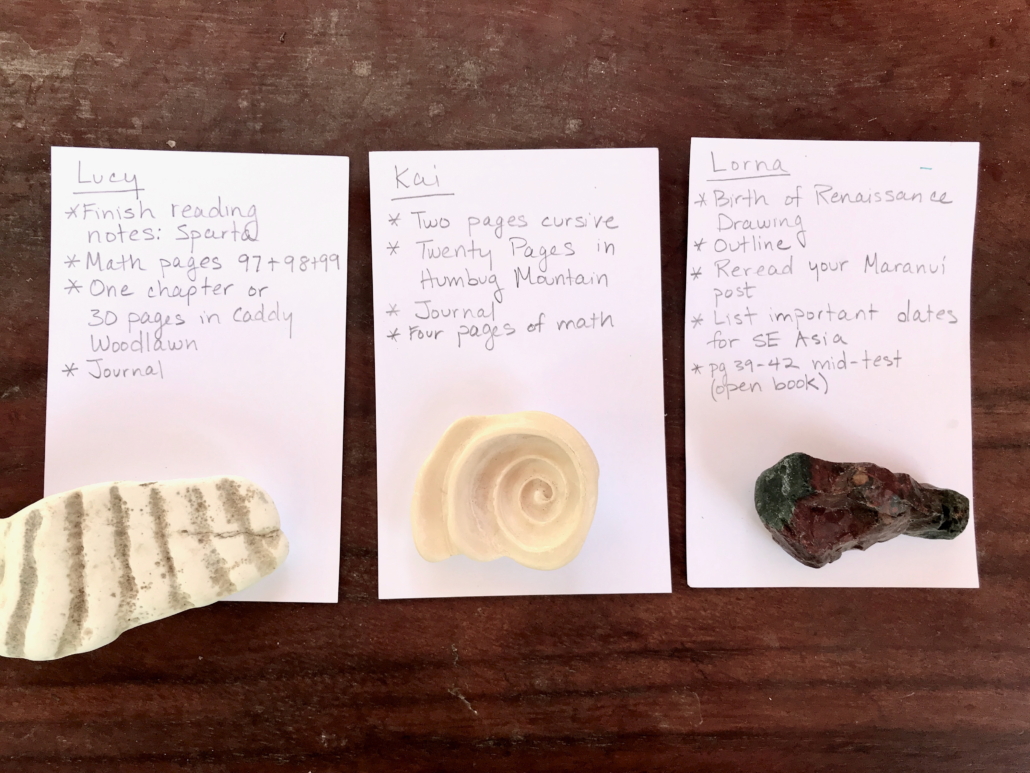
We did “school” about 30 percent of our days. Surprisingly, the three kids enjoyed the structure of “school days.” Maybe it gave them confidence that they wouldn’t fall behind? For us, a half-day worldschooling lesson might have looked something like this:
* Practice “find the errors” and dictation (see page 223) in their journal, using learning points and spelling words from our geographical location. Review together and help them correct.
* Complete two pages in the math book.
* Learn about one new thing—for example, paragraph structure, photosynthesis, haiku, or the three Noble Truths of Buddhism.
* Do chore(s).
* Have forty-five minutes of structured and self-paced writing portfolio time.
* Reading time: independent, guided, or with a parent.
* Done. Out the door. Go explore.