
Stories from the Road – Naxos, Greece
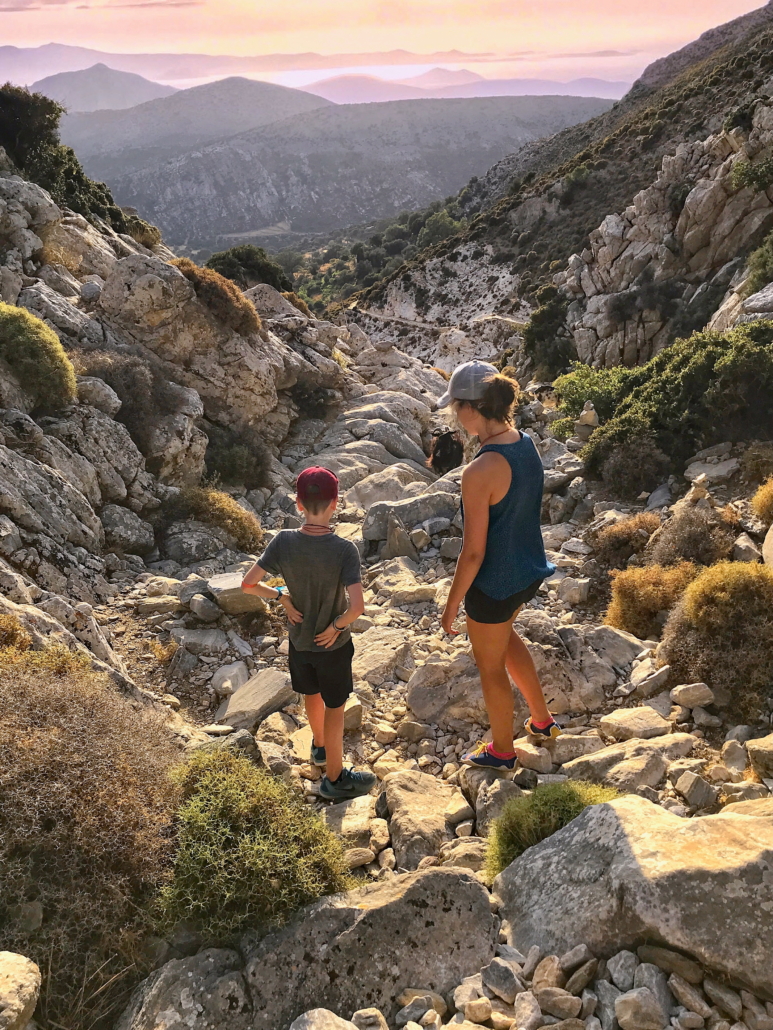
Past the freshwater spring, the well-maintained trail has been petering steadily out. We find ourselves using arms and legs to scamper up the hillside. A goatherd and his tinkling, shaggy charges are on the opposite valley wall.
“I see it!” says Lucy, pointing to a doorway cemented into the hillside.
“Finally!” says Kai.
Passing the threshold into the cave takes us from arid to humid, from hot to cold, from light to dark, from the profane to the sacred. We have arrived at Zeus’s cave, on Naxos in the Greek Cyclades.
The cave is more than fifty feet high and at least double that in width. Some stories say that he was born here, others that he hid here during his teenage years from a jealous father, and a man in the village even told us that Zeus received his thunderbolt from an eagle on top of this mountain.
We are silent, walking the smoothed pathways that Zeus walked, breathing the air of his boyish fragility or his teenage angst. He is embodied. Behind the teal and green moss, drip-drops of moisture echo across a dark cavern. The light beam from my phone cannot take in the size of this place; I have to imagine the extent of its reach.
We have been studying the Greek gods, their powers, symbols, and interrelational dramas. We’ve read classic myths, written our own original myths using Olympian characters, and visited the many temples during our monthlong stay in Greece.
Our landlord told us about the cave—turn left at the potato patch and take the right fork at the white square house—giving directions that describe every intersection on the island. Getting here has been an epic quest requiring intuition, clues, research, and asking as many locals as possible.
For a nine- and ten-year-old, the myth and magic are real. “He must have been super tall, even as a kid. Where did he put his head when he slept?”“Did someone bring him blankets?”
For my thirteen-year-old, the isolation fuels empathy. “Who did he have to talk to?”
We try to orient where he would have cooked and ate. We take in his view when he stepped outside of his cave—to his left, the tallest mountaintop in the Cyclades, currently named Mount Zeus, at 3,300 feet, and to his right, a valley that tumbles into the island-dotted sea below. He could have seen visitors a long way off.
This cave kept our Zeus safe, timestamped his childhood, and prepared him for his extraordinary life ahead.
For more stories and inspiration, check out our book, Wonder Year: A Guide to Long-Term Family Travel and Worldschooling. You can also sign up for our quarterly newsletter below and follow us on Instagram @wonderyeartravel. Our mission is to help you find your way out the door and into the world.