
Stories from the Road – Somewhere in the Amazon, Brazil
They tell us not to take anything out of the jungle.
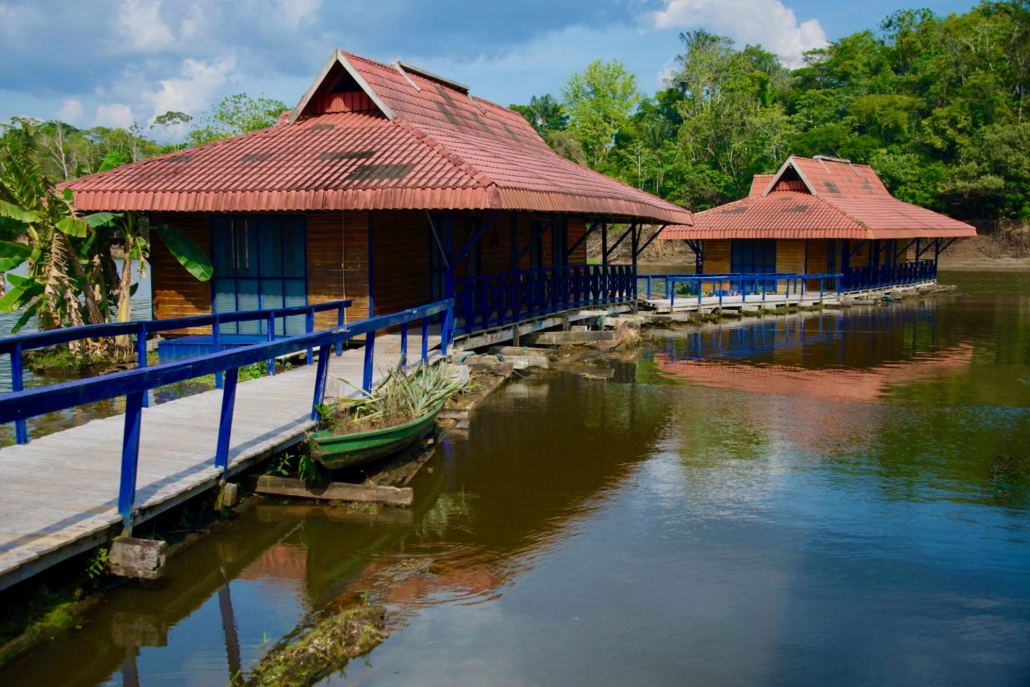
It is our last day at Pousada Uacari. Situated at a tight bend in the Japurá River, a wide feeder to the Amazon about a mile away, it is a place so remote that its location was described to us simply as “two hours by boat from Tefé.” Our small room, at the end of a narrow wooden walkway, floats atop the river on enormous Styrofoam pontoons. It contains four single beds and a small bathroom with a shower that pumps recycled river water from a rooftop tank. Our countless roommates—roaches, spiders, and lizards—make us grateful for the bed nets that Mark tucks around the boys and me each night before crawling under his own.
The day before, Asher had speared a river piranha, and we ate it sushi-style for lunch. We’d ventured out in a narrow aluminum canoe for an evening paddle surrounded by giant caiman watching us from the water, all eyeballs and teeth. I’d been sucker-punched in the face by an airborne fish attracted by our boat’s headlight in the pitch black. Gathering on the floating dock back at the lodge, we had stayed up late to view a total lunar eclipse, munching popcorn like we were watching Earth’s biggest blockbuster movie. We would have liked to sit at the edge of the dock and cool our feet in the water, but we didn’t dare. We are fine to take nothing home with us. Even touching anything is risky business.
Our trackers meet us early this morning for a hike across a peninsula lying between the main river channel and an intersecting tributary. They are three local tribe members whose family roots run deep into the basin. Carrying blue jugs of water and red backpacks with white crosses, they have machetes hanging at their sides. We all do our best to bridge Portuguese and English, and with earnest intent, hand gestures, and lots of smiles on both sides, are able to communicate fine.
Our hike is an hour away by canoe. Ronan spends the journey deciphering birdsong and monkey howls. Storm clouds gather above the forest canopy, bathing the jungle in a grayish-yellow light as we slide our boat onto the bank. Disembarking into shin-deep mud, it’s clear that the land has spent most of its year underwater. Leaves with no crunch cover dank earth dotted with stagnant pools of water. There are thickets of thorny shrubs and beautiful orchids perched in the crooks of spreading branches.
There are no trails, and I hang a few paces back, watching my boys bushwhack their way through the dense vegetation. Everyone but Asher and our lead tracker, João, who are the same height, have to bend forward as we walk. The river fades from sight, but we can still sense the low hum of its flow as we trek to an enormous kapok tree taking center stage in the marshy glade. Its roots stand taller than all of us, and vines drape around its trunk, creating eerie spaces to walk through. Ronan spots a line of giant ants carrying larvae from one home to another. A guide shows Asher the tracks of a large jungle cat. Captivating creatures abound, but we’re in search of one in particular: the elusive sloth. Travelers from around the world come here to spot them, and we haven’t seen one all week. The boys are especially excited by the possibility of finding this exotic, smiley soul.
It’s Ronan who spots one first. Tapping João on the shoulder for confirmation, he points to his own eyes, then holds up two curled fingers. It is a mother two-toed sloth with a baby wrapped tightly around her back. After that, sloth “hide-and-seek” comes more quickly, and we soon locate several, so well camouflaged that they blend into the mass of leaves above. Our guides eye a three-toed male slowly returning to the heights of a giant fig tree. Sloths live in the trees and come down only once each week to poop in an ever-growing pile on the ground. Now, on his unhurried return climb, he is so close above our heads that we can see the gnats buzzing around his exposed face.
One of our guides points to his watch—time to go. We hack a new path through the jungle to the boat, where our gear is already loaded for the long trip back to Tefé. At the port, we heave our bags to the taxi driver on the other side of the gangplank and pile into his small car. Inside the tinted windows with the air-conditioning on max, the heat is staved off, but the smell is thick, ripe, and overwhelming—something like rotten fruit.
After we’ve been dropped off at the airport and are waiting in line, I notice Asher holding his nose. “That taxi smelled pretty awful, didn’t it?” I ask. He squeezes his nose tighter, shakes his head, and with his other hand, points at Mark.
Our heads lower to Mark’s “mud”-coated hiking boots. He was the one who had stood directly under the sloth. “Dad, you took something out of the jungle…” Asher says, with a grin spreading across his face.
For more stories and inspiration, check out our book, Wonder Year: A Guide to Long-Term Family Travel and Worldschooling. You can also sign up for our quarterly newsletter below and follow us on Instagram @wonderyeartravel. Our mission is to help you find your way out the door and into the world.