
Stories from the Road – Deadvlei, Namibia
We wake at 3:30 a.m., having committed to a desert safari in Namib-Naukluft National Park that starts at 4:00. Unlike a typical safari into a fauna-rich savanna, our aim today is to explore the massive sand dunes in the oldest desert in the world.
At this hour, and without moisture to cloud the stars, we have no trouble seeing the universe spread above our heads. The boys remark on the profound quiet. There are no planes flying over, no road noise bouncing across the barren plains—only the distant sounds of jackals announcing a kill echoing across the vlei.
Ronan is psyched when he sees the safari truck, a repurposed Toyota Hilux with a mounted bed insert to accommodate nine passengers in open-air theater seating. We sit four across. Our guide hands us a worn woolen blanket, perfect for one but insufficient to shield us all against the bracing predawn wind. We rearrange and put the boys in the middle so they get the most warmth.
The road is like those we drove on yesterday to reach our outpost: gravel and dirt. Ninety percent of Namibia’s roads are unpaved, and although great effort is made to keep them in good condition, sections still make for a rough traverse. The temperature drops further as we near the entrance to the national park, where a wall of cool fog fills the valley. From the Sesriem entrance gate, our eventual destination is the Deadvlei claypan.
Along the way, we see mountain zebra, oryx, and ostrich, and we learn that there are five types of sand dunes. Those in Namib-Naukluft are star dunes, which means they have been formed by winds coming from multiple directions over the past several million years.
At Big Daddy, an over one-thousand-foot-high dune overlooking Deadvlei, we stop and venture out to climb one of those star dune’s rays. The dune is massive, and the line of hikers stomping up the ridgeline ahead of us nearly disappears in the haze between sand and sky. Ronan bounds out of the truck and starts the heel-toe-heel-toe trek along the narrow channel laid down by hikers across the years. Mark, Asher, and I fall in behind.
The air is warming quickly, and our elongated shadows stretch down the dune’s side. There are no climbers passing us on a return journey, and our guide explains that’s not the way out.
Instead, we turn perpendicular to the trail and launch down the southern face of Big Daddy toward the cracked white claypan below. High-stepping in the soft red sand, Asher calls out that he feels like an astronaut on Mars. He grips Mark’s hand as they serpentine to provide some semblance of control over gravity.
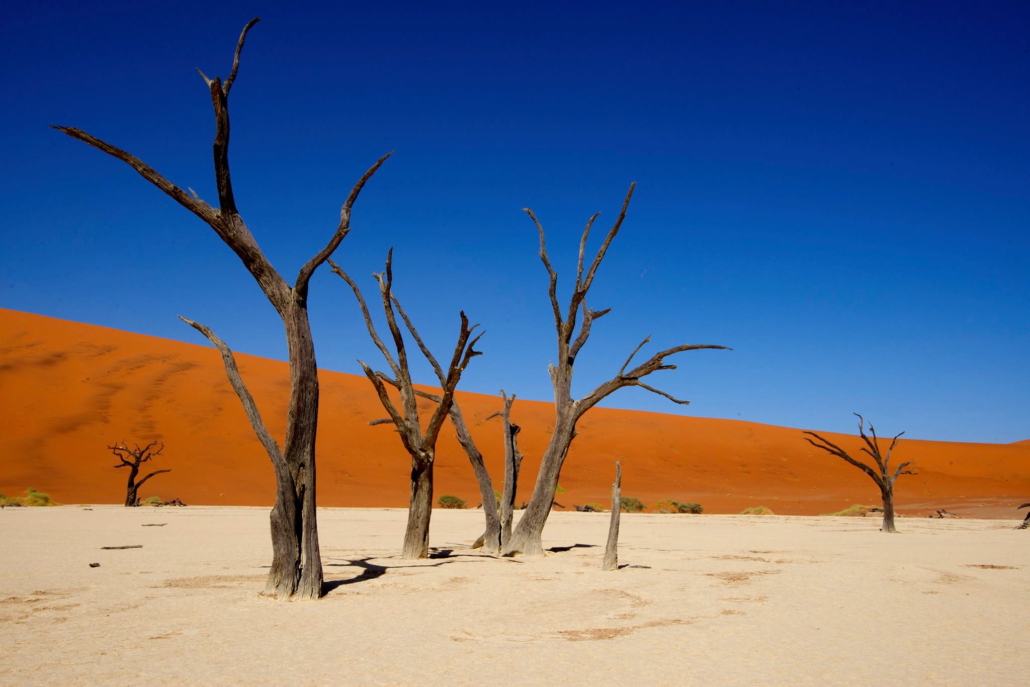
At the base of the dune is Deadvlei, famous for its austere beauty. About six hundred years ago, ephemeral waters that flowed into the marsh during the rainy season stopped when the river cut a new course. The acacia trees that had filled this basin died, and because there isn’t enough water to rot the wood, they still stand—blackened by the unforgiving sun. The combination of deep-ocher sand, pale-gray pan, inky acacia skeletons, and the brilliant azure sky make the vlei otherworldly. Astronauts, indeed.
Ronan directs a family photo shoot, and we capture a rare image of all of us together, frozen in time within our frozen surroundings. Even in the now-scorching heat, we want to linger, but our safari mates are ready to go, and our guide aims to secure a prime spot beneath the cooling branches of a tree for brunch. We marvel with our fellow hikers over coffee, fruit, and bread.
Our final stop is a nearby canyon. While the rest of our group climbs down into the gap, the boys elect to stay closer to the truck, weary. After many weeks on the road and the long drive the previous day, we feel stretched thin, diluted.
Back at the outpost, we have dinner in a common room lit only by candles. Asher eats kudu, an ungulate he’s seen grazing among the dunes. Our tent cabin has an upper deck, and we go up for stargazing before returning “down-ladder” to sleep. In the US, it is hard to find places far enough away from artificial light to really see the stars. In Namibia, the closest light is hundreds of miles away. Our eyes adjust easily to the darkness, and the universe takes center stage.
We are totally alone, together, lying on our backs as the stars come into focus. We don’t need to, but we whisper softly to one another. The boys point out satellites and meteors, and we try to identify the constellations, many of which are different from what we know at home. At twenty-four degrees south latitude, the universe is unfamiliar.
For more stories and inspiration, check out our book, Wonder Year: A Guide to Long-Term Family Travel and Worldschooling. You can also sign up for our quarterly newsletter below and follow us on Instagram @wonderyeartravel. Our mission is to help you find your way out the door and into the world.