How We Worldschooled – Julie’s Family
I have always loved math and was not too concerned about helping Johnny with mathematical functions, word problems, and practical applications. We purchased the math books that fourth graders use in our school district and tried to work through them over the year. Learning the multiplication tables was important, and Johnny also practiced addition and subtraction in an applied way, pretty much daily as the keeper of the gas and mileage log while we were on the road.
It became a practice to mark the starting and finishing mileage whenever we were on the go. We could calculate weekly or monthly totals and averages. We could check to see how our fuel efficiency changed at different speeds and elevations. Math went great, and eventually I got rid of the math books and focused more on real-life applications.
We also read a lot. Picking out books was a fun chance to dive into local stories, history, and characters. The hands-down family favorite was *The Captain’s Dog: My Journey with the Lewis and Clark Tribe*, in which Meriwether Lewis’s dog, Seaman, tells the story of the adventurous search for the Northwest Passage. Reading along while we were tracing Lewis and Clark’s journey, with our own dog, was perfect.
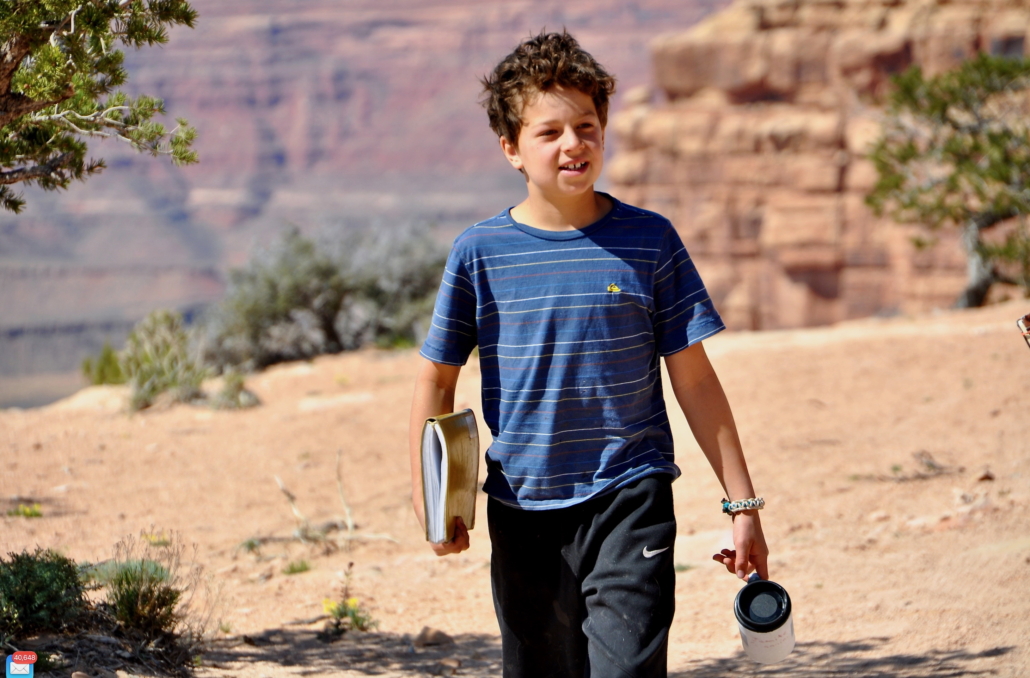
Everyone also kept a journal. We bought Johnny a gorgeous journal before the trip, and while we did not enforce a daily entry, he wrote with fervor and heart, and to this day, he keeps his journal by his bedside to revisit.
An excerpt (reprinted with permission):
Johnny, age eight:
*Right now I am in the top bunk of a cabon, wich is one of the four on \[Hesketh] Island. I can see a rose boosh and in the background the ocean. I can hear the faint sound of the waves crashing. I am inside but allthoe I have been outside \[all] of the day, I can almost smell the spray of the salt water. It is just backing off from high tide. Yesterday I cought my first two fish . . .*
And other than math, reading, and writing, we improvised, following Johnny’s curiosity. We made a ritual out of the US National Park Service Junior Ranger program (many state parks have similar programs), an excellent, place-based resource that is focused on the local topography, ecology, geology, and culture. Completion of the work at each park earns a badge; Johnny collected twenty-eight Junior Ranger badges over the course of our year.
With our interest in sustainability and love of skiing, we created a module on the environmental impacts of ski areas and set up meetings with operators, managers, and environmental staff from different organizations, including ski areas, ski manufacturers, local government, and environmental groups. We dug avalanche pits, studied snow layers, hung out with avalanche dogs, and learned about snowmaking operations and the new technology to minimize water use and maximize use of snow fencing. And we did a lot of “mountain fieldwork.”
A typical day:
Johnny makes the family breakfast: scrambled eggs with spinach on corn tortillas with shredded cheese and salsa. We take a three-hour hike through an old-growth forest, learning to identify coastal hardwood varieties, fungi, and ferns. Stop for an hour diversion to test our balance on fallen trees, walking backward and forward, sideways, and on one leg. Hop, hope, listen.
Get back to the rig. Study the analog map; decide to stay another day because it’s so gorgeous and we have nowhere else we have to be. Johnny builds an elaborate rock sculpture/rock-climber course for his RC vehicle. Julie makes bebe soup—veggie broth with kale and capellini, lemon zest, and Parmesan. We eat outside. We write a blog post, then read aloud. Johnny and Charlie go on a night photography stroll. Julie and Max (the dog) read some more and snuggle.