
Stories from the Road – Bayeux, France
It is an early and unusually quiet start as we carefully navigate the narrow streets out of Bayeux, France. The village is our base camp for several days of exploration in the Normandy region and an opportunity to learn about its historical significance—from its founding as a Gallo-Roman city in the first century BCE to the rise of William the Conqueror to its liberation from the Nazis in World War II.
As Mark accelerates the sleek black Citroën station wagon across rolling pastures and past ancient stone barns, Ronan leans toward the front seat and, presumably out of concern that his brother is asleep, whispers a question.
“Why were there so many American flags hanging in the town?”
I hadn’t noticed, but he is right. Bayeux is festooned with various national flags integrated with the cityscape—painted on the windows of restaurants and bakeries, strung along wires between buildings. The Tricolore, the Union Jack, the Maple Leaf—and the Stars and Stripes. I don’t want to answer immediately a question I hadn’t even thought to ask myself.
“Might have had something to do with the war, yes?”
He doesn’t respond, and I don’t press.
I see his gaze return to the landscape, still lush with late-summer green. This part of France reveals no horrors or tragedies upon its impassive fields and gardens but rather does only what it has done for hundreds of years—it feeds its people.
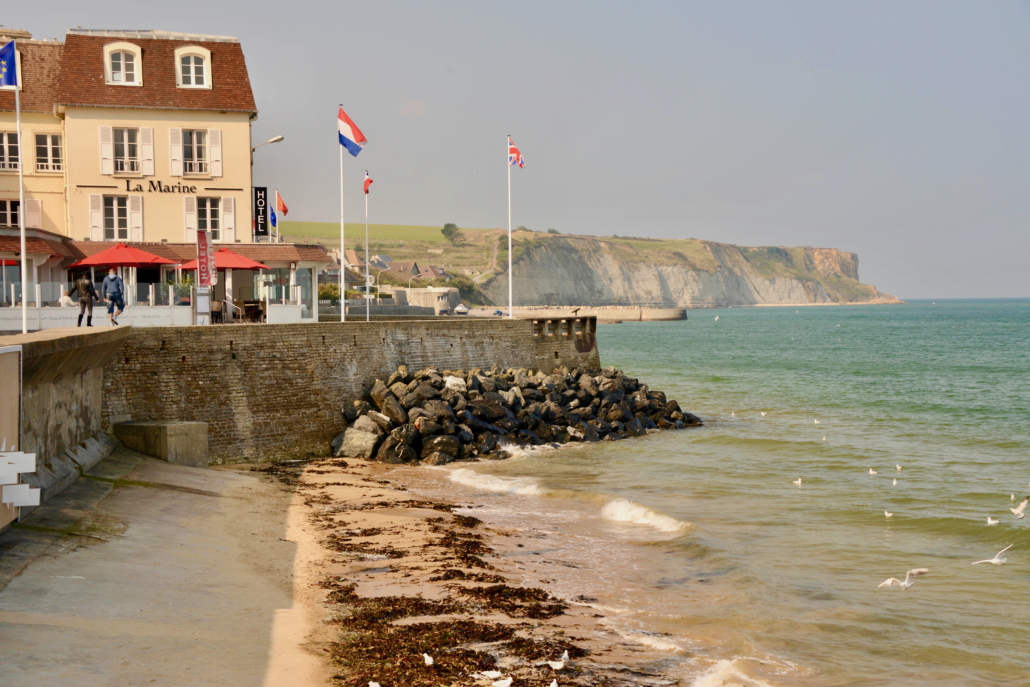
We visit Arromanches-les-Bains, a critical support position for securing and holding the deepwater ports of Le Havre and Cherbourg. We walk the German artillery battery at Longues-sur-Mer, the boundary between the Omaha (US) and Gold (UK) beaches, where the four 152 mm gun placements, in various states of destruction, now serve only as minor impediments to a local farmer. Ronan and Asher stand at the ridge of Pointe du Hoc, a position that reduced a US commando force of 225 to 90, and wonder aloud how that many soldiers could have climbed its steep bluff.
We finish at the Normandy American Cemetery and Memorial in Colleville-sur-Mer. In the museum, the deeply personal stories of those who lost everything during the assault prompt the boys to imagine their great-grandfathers fighting in this war and leaving their families behind.
On the rise overlooking Omaha Beach, there are more than nine thousand remains permanently interred beneath white stone crosses and Stars of David. Our voices soften as we walk the grounds of this holy place, where young men so faithfully committed themselves to empathy, liberty, and sacrifice.
The ride back to Bayeux is silent amid the darkening sky. As we enter the central historic district on the way to our hotel, we drive past a café with a large American flag painted on the plate-glass front, and I turn around to look at Ronan in the back seat. As our eyes meet, I realize he has answered his own question.
For more stories and inspiration, check out our book, Wonder Year: A Guide to Long-Term Family Travel and Worldschooling. You can also sign up for our quarterly newsletter below and follow us on Instagram @wonderyeartravel. Our mission is to help you find your way out the door and into the world.